Category Archives: Uncategorized

The Greatest Show on Earth 1952

gse001

Paramount Pictures

The circus traveled by rail as demonstrated in Cecil B. DeMille’s Technicolor masterpiece of 1952. Winning the Oscar for Best Picture, this is the film that made Charlton Heston a star.

For this review, I concentrated on circus scenes that had trains in the background. Some highlights include an Atlantic Coast Line (ACL) steam locomotive and caboose, a Pennsy GG-1 electric and a elaborately-detailed scale model of the two circus trains.

Our review begins 19 minutes into the movie as the Ringling Brothers and Barnum & Bailey Circus (RBandB&B) prepares to leave its Winter Quarters in Sarasota, Florida.

gse008

It took hundreds, if not thousands of people to operate the circus. As wagons of equipment are loaded piggyback-style on the left, performers and support staff prepare to board the passenger train on the right.

Continue reading

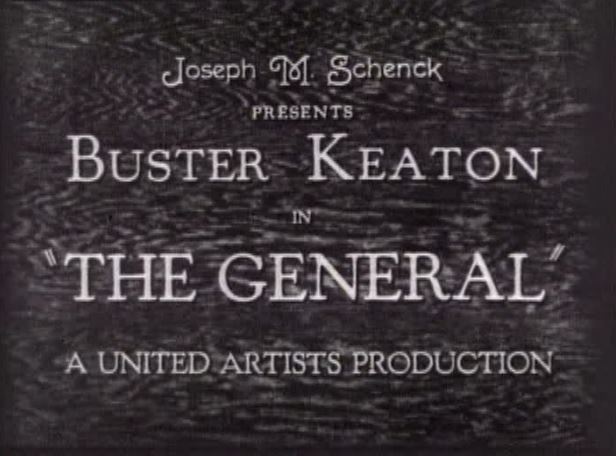
The General 1926

gen001 gen002

United Artists

Buster Keaton’s masterpiece from 1926 is both a silent picture and black and white, which makes it about as obscure a train movie to modern audiences, as can be. Based on the true-to-life Andrews Raid during the Civil War, location shooting took place on the Oregon, Pacific & Eastern railroad near Cottage Grove.

Filmmakers were able to discover three 4-4-0 locomotives in Oregon to use for the movie. They were:

OP&E #4, built by Cooke Locomotive Works in 1886. This became W&A #3, “General”.
OP&E #5, built by Baldwin Locomotive Works in 1881. This became W&A #5, “Texas”.
OP&E #1, built by Baldwin Locomotive Works in 1881. This became USMRR #8, unnamed.

Chock full of railroad scenes featuring some incredible stunts by Keaton, I had a difficult time chopping down over 200 screen caps to a manageable 64 for this review.

Our story begins in 1861, Marietta, Georgia….

gen012 gen016

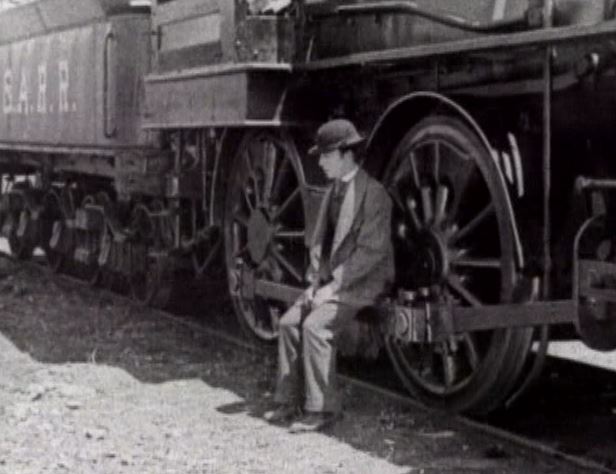
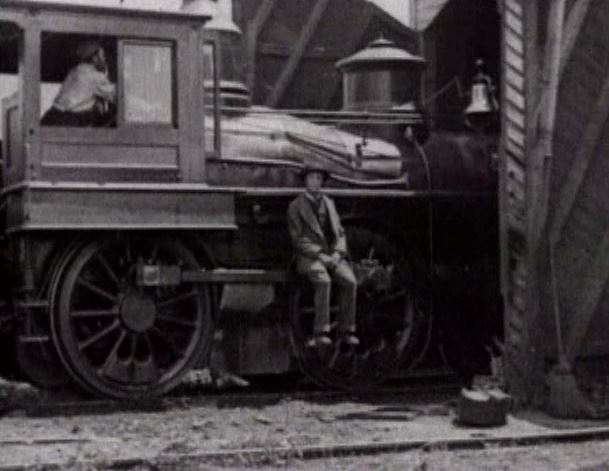
…where a despondent Johnnie Gray (Buster Keaton) has been denied enlistment, account being too valuable as an Engineer on the Western & Atlantic (W&A) Railroad. As he rests on the main driving rod of the 4-4-0, a hostler moves General into the shed.

Continue reading

Bad Day at Black Rock 1954

bad001 bad009

Metro-Goldwyn Mayer

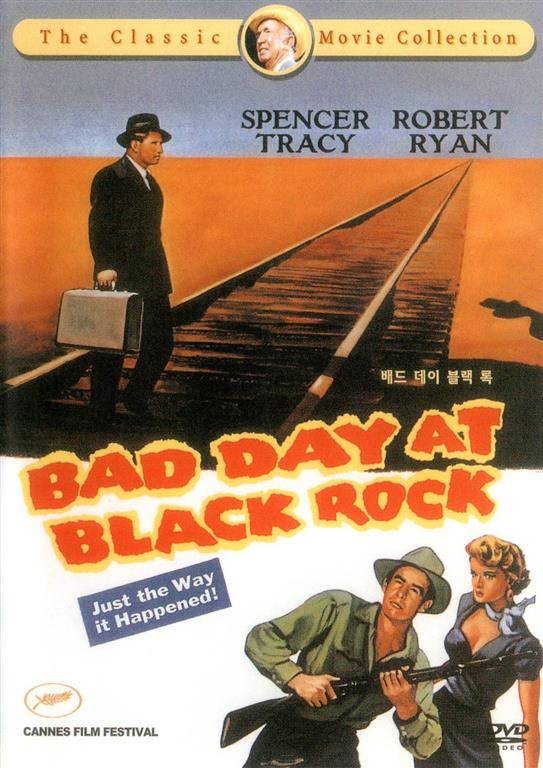
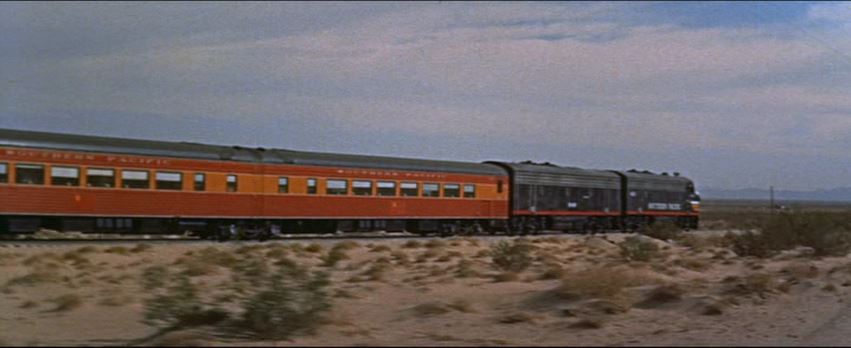
Wow, what an opening! Southern Pacific Railroad hosted one of the most spectacular railroad-themed opening credits ever done for a movie. The star is an SP passenger train in splashy “Daylight” dress led by a pair of equally classic “Black Widow” EMD F units.

Helicopter shots, distant shots, pacing shots were all added by associate producer Herman Hoffman after principal photography had ended. Test audiences had been unimpressed with the rather bland movie opening, so MGM rented a couple trainsets from Espee for filming on SP’s “Jawbone” line near Lone Pine, CA.

Once again, I am grateful to IMDb Trivia and particularly James Tiroch at Cinetrains for details about the railroad operations. The comments from Cinetrains/The Black Widow of Black Rock were extremely helpful in identifying the equipment used.

Let’s take a look at the zenith of Southern Pacific passenger cars led by silver-nosed freight engines as they barrel through the desert.

bad016

In a pacing shot, EMD F3A #6151 and EMD F7B #8149 are towing an articulated chair car (note the single truck between the two cars).

Continue reading

Other Men’s Women 1931

mens126 mens001

Warner Brothers

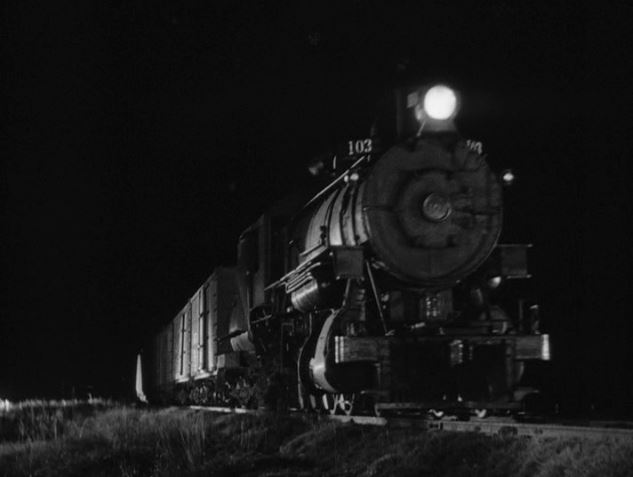
Southern Pacific Lines and their subsidiary San Diego & Arizona (SD&A) gave movie-makers carte blanche in filming this railroad-themed motion picture. The star of the show is a chunky little 2-8-0 SD&A #103, a C-8 class steam locomotive (Baldwin 1904). There’s a host of other Espee steam power seen in passing to keep things interesting.

Lots of action (this being a Warner’s picture) including crewmen on the car tops, bailing off and on moving trains, a couple fist fights in the cab and an actual side-swipe wreck of two trains. Future big stars, James Cagney and Joan Blondell make brief appearances in minor roles.

So let’s climb aboard and see Southern Pacific Railroad in all its glory as it rolls through Southern California in the early 1930’s. Highball!

mens042 mens066

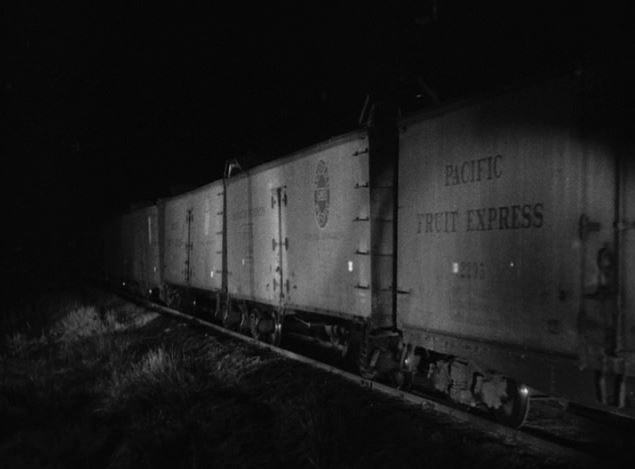
SD&A #103 trundles through the night with a long string of Pacific Fruit Express refrigerator cars bearing both Southern Pacific and Union Pacific markings.

Continue reading

Emperor of the North 1973

emp038 emp058

20th Century Fox

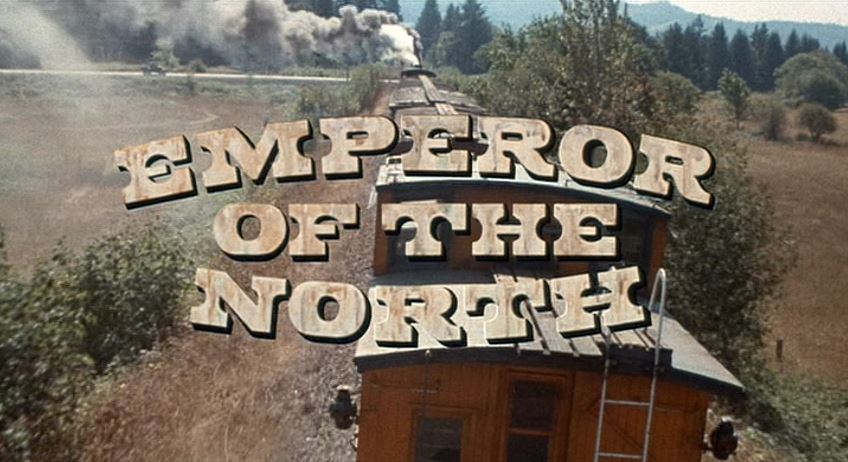
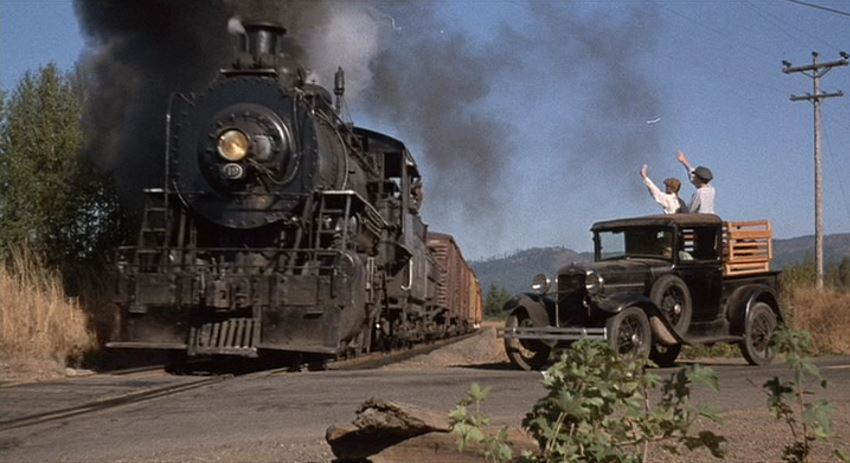
Filmed along the Oregon, Pacific & Eastern short line, this movie treats us to TWO operational steam locomotives pulling an eclectic mix of rolling stock past the cameras. The train scenes are sublime although the actors employed frequently go way over the top in the overacting department. Shatner-level carpet chewing. Anyway…

The real stars are OP&E #19 (2-8-2 Baldwin-built 1915) and OP&E #5 (2-8-0 Alco-built 1922) and happily, both engines are still with us. #19 is being rebuilt at the Age of Steam Roundhouse and #5 can be found at the Galveston Railroad Museum (renumbered to 555).

Many thanks to James Tiroch’s Cine Trains Project for helping me identify the heritage of these locomotives. The link includes an exhaustive history of both locomotives.

Oh, the actors? Well, filmmakers brought on board three ENORMOUS hams, Borgnine, Marvin and Carradine, but I’ll be ignoring them for the most part. There’s far too much steam locomotive pulchritude to savor instead. Highball!

emp135

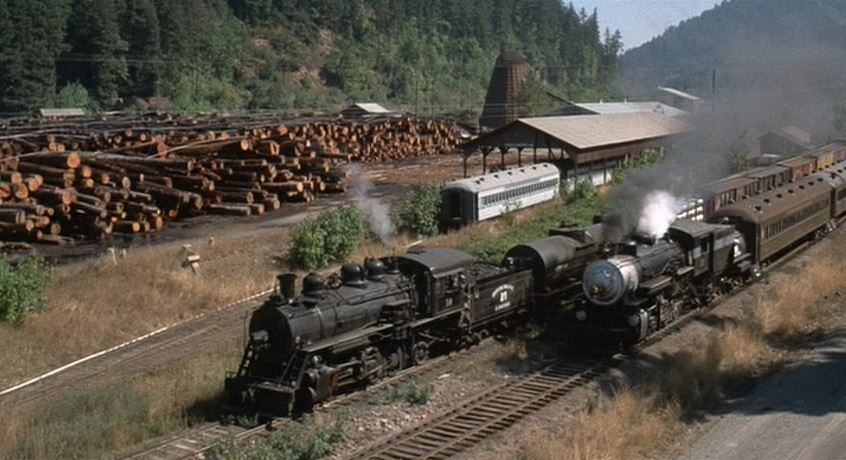
OP&E #5 on a passenger train overtakes OP&E #19 in the siding with a freight. In the background, we see a lumber mill featuring one of those cool, old-time wood waste burners. OP&E #5 (appearing here as #27), also was seen as #4 in the movie.

Continue reading

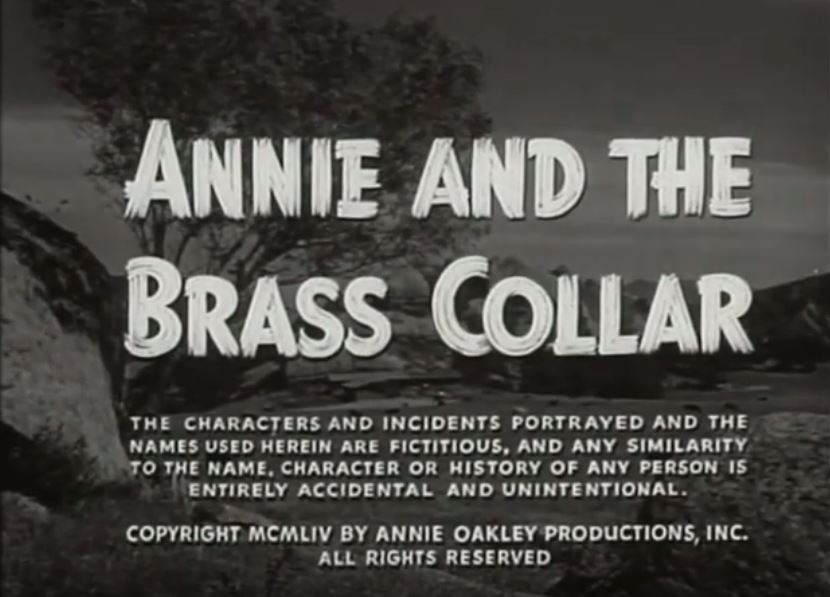
Annie and the Brass Collar 1954

anne002

Annie Oakley Productions, Inc.

Train Robbers are afoot causing all sorts of havoc along the SP&W Railroad. Famous western sharpshooter Annie Oakley (played by Gail Davis) is called in to help bring the outlaws to justice.

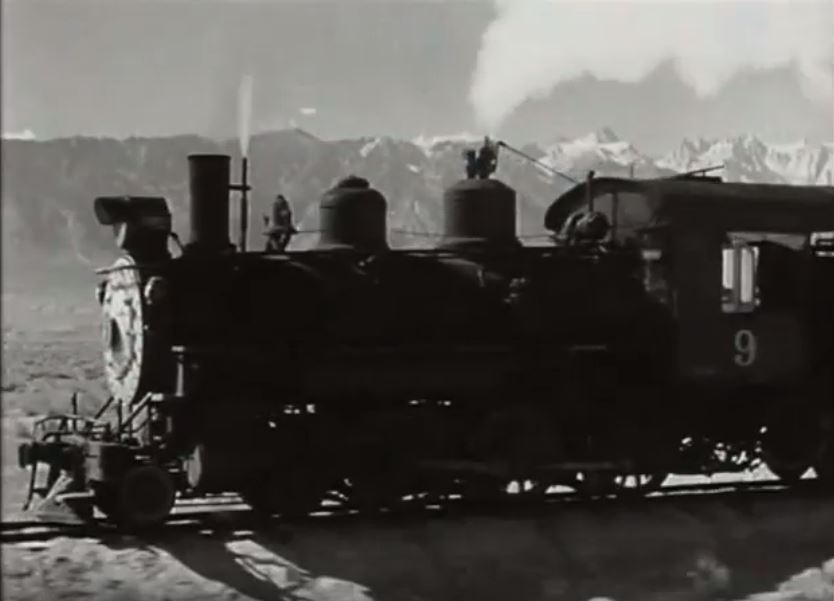
Filmed along Southern Pacific Railroad’s bucolic narrow gauge line (SPNG) in the Owens Valley of California, the picture stars SPNG #9, a 4-6-0 Baldwin built in 1909. Annie and the Brass Collar was the first episode of the Annie Oakley TV show which ran for three seasons (81 episodes) until 1957.

Lots of train action in this short (30 minute) show, so let’s get started.

anne015

Old #9 is pedaling along furiously on its 44″ drivers as the bad guys make their move.

Continue reading

The Long Summer of George Adams 1982

lsga001 lsga012

Warner Brothers

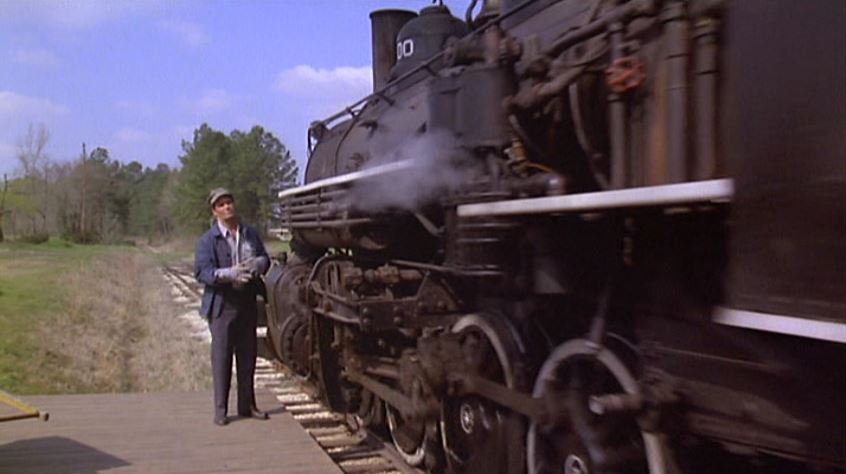
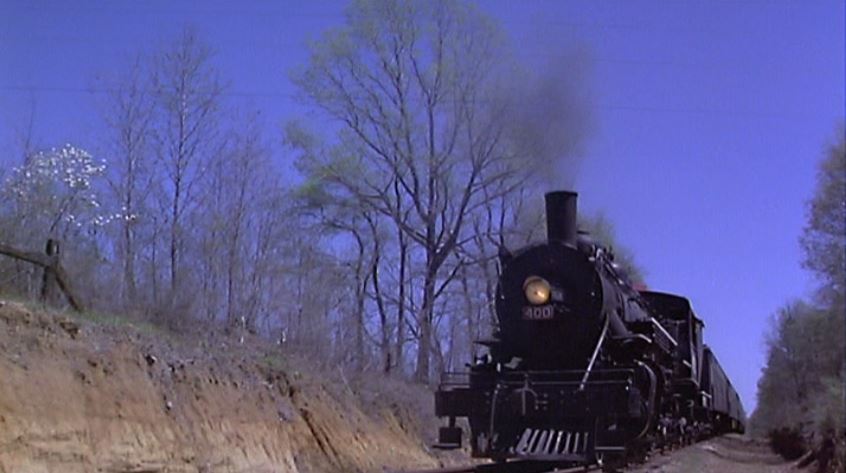
This made-for-TV movie stars TWO steam locomotives. The first is Texas State Railroad [TSR] #400, a Baldwin 2-8-2 built in 1917. The second is an Alco RS2 diesel locomotive #7 built circa 1947. (Alco diesels were always referred to as “honorary steam engines” by railfans, due to the copious amounts of black smoke belched skyward upon starting.)

#7 started life working for the Point Comfort & Northern Railroad in Texas, coming to TSR in 1975. Since this movie was filmed, the #7 has been repainted into a beautiful Southern Pacific “Black Widow” scheme.

James Garner (Yes, Mister Rockford Files) is the lead character in our motion picture and the film is the story of a mid-20th century railroad worker about to lose his job due to diesels replacing steam.

Many thanks to good friend Scott Tanner who slipped me a DVD of this flick for inclusion on this blog. And now, let’s see Rockford and the boys playing with their trains!

lsga066

It appears to be early spring as TSR #400 and train roll through East Texas.

Continue reading

The Man Who Shot Liberty Valance 1962

libv002 libv001

Paramount Pictures

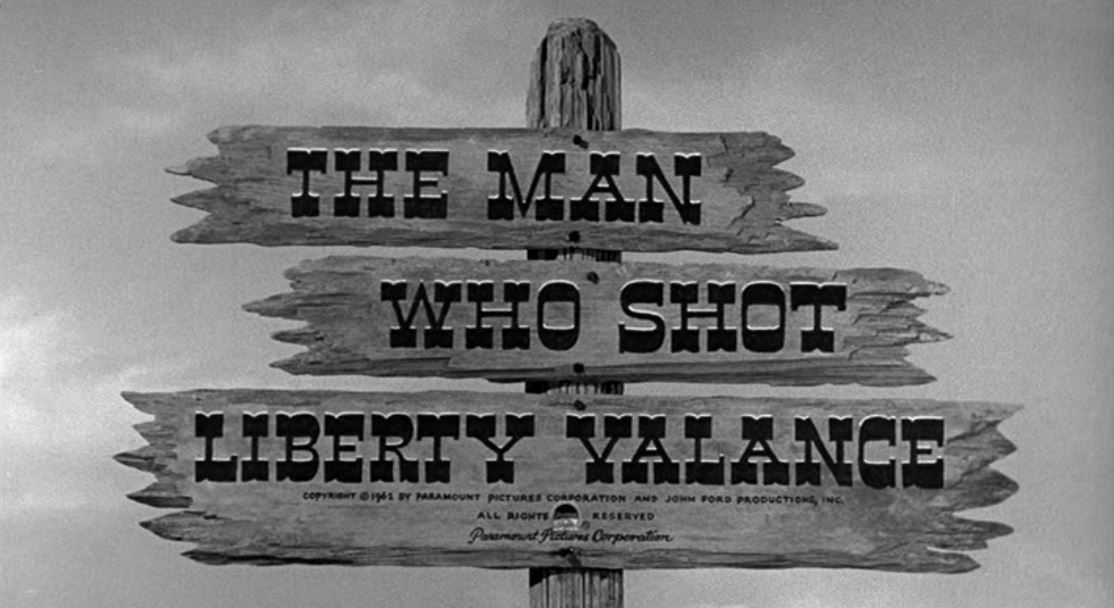
This film, a classic though it is, was a bit of a disappointment in the train department as we only get brief scenes at the beginning and end of the picture. Our star is the former Virginia & Truckee 4-4-0 #22 “Inyo”, an 1875 product of Baldwin Locomotive Works — at the time owned by Paramount Studios themselves.

The story is told mainly in flashback with the railroad representing progress and civilization brought to a small, lawless Western town. In addition to studio scenes of the Inyo, there is what appear to be stock footage of a train on the Sierra Railroad.

Let’s take a closer look at the three, distinct scenes in “Liberty Valance” of a steam engine-powered passenger train.

libv043

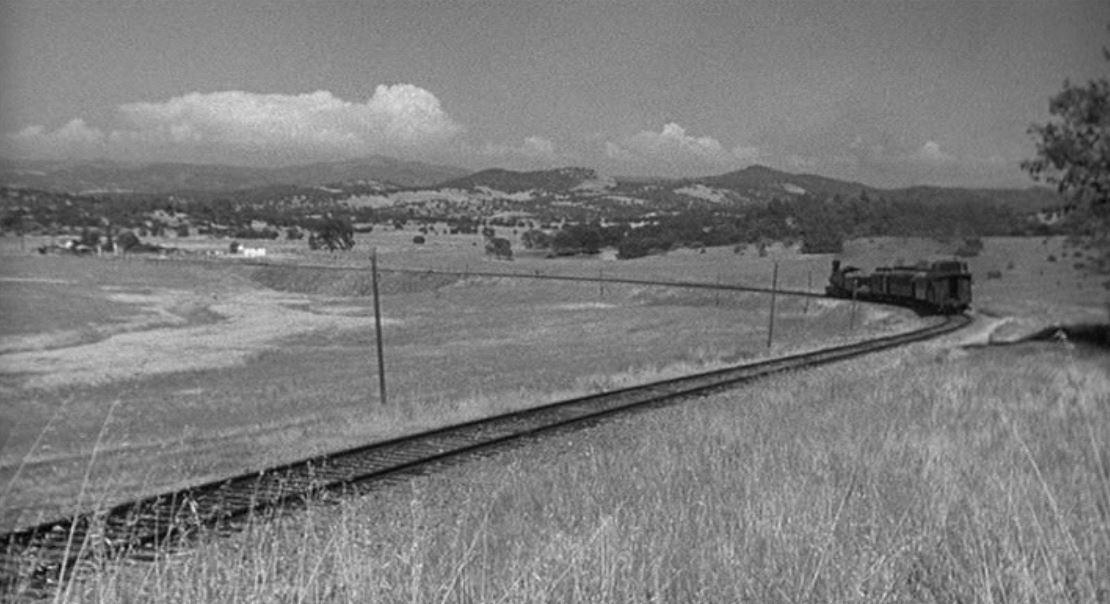
As the movie comes to an end, we see a mixed train (steam locomotive, flat car, two dark-colored coaches, one light-colored coach and caboose) rounding a curve away from the camera.

This is most likely a scene along the Sierra Railroad with possibly the #3 locomotive on the point.

Continue reading

Back in the High Life Again 1986

back027

Island Records

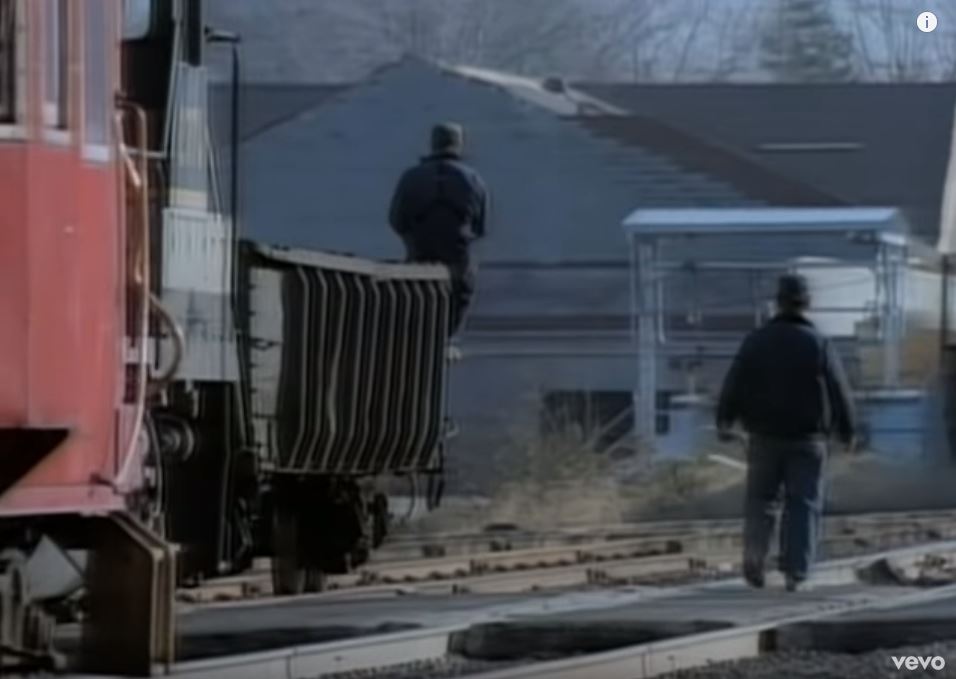
How about a music video? Hey, if it’s in IMDb.com, it’s a movie! All four minutes of it.

Seriously, Steve Winwood packs a fair amount of train and railroad-related action in those 240 seconds. It’s a quickie snapshot of operations on the old Southern Railway mainline through Manassas, Virginia.

Aside from the railroad bits, it’s an interesting story about how the song was written and the music composed.

At the time of filming, the Southern had merged (1982) with Norfolk & Western to form Norfolk & Southern Railway, still a big Class 1 railroad to this day.

Let’s see how the MTV crowd (back when they actually played music television) interpret trains into this video.

back020

A Southern Railway local freight does some switching in Manassas, Virginia. Just barely in shot is a red, bay window caboose and an EMD Geep of some sort switching a gondola onto a siding.

Continue reading

Some Like it Hot 1959

hot001 hot002

United Artists

Tony Curtis is “Josephine” and Jack Lemmon is “Daphne” in this screwball comedy featuring 24 minutes of the boys dressing up as women to travel with an all-girl band on board a train headed for Florida. What’s not to like?

Add to this frothy situation the presence of Marilyn Monroe as Sugar Kane Kowalczyk and travel on an old section Pullman sleeper never looked better.

According to IMDb Trivia, filmmakers used Pullman heavyweight, “Clover Colony” for many of the interior shots. This car is still with us and can be visited at the Tennessee Valley Railroad Museum.

hot002a

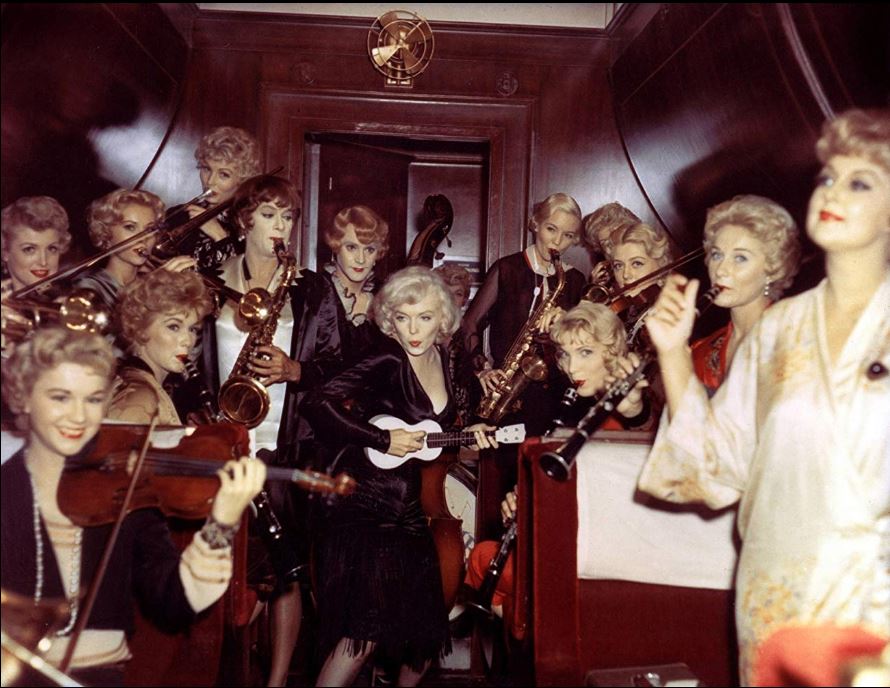
Although the movie was filmed in black and white, many of the studio stills were in color including this group photo of the girl band onboard Clover Colony.

I swear that looks like Angela Lansbury on the far right, but she’s nowhere listed in the film’s credits. It was most likely actress Joan Shawlee who played bandleader Sweet Sue.

Continue reading